
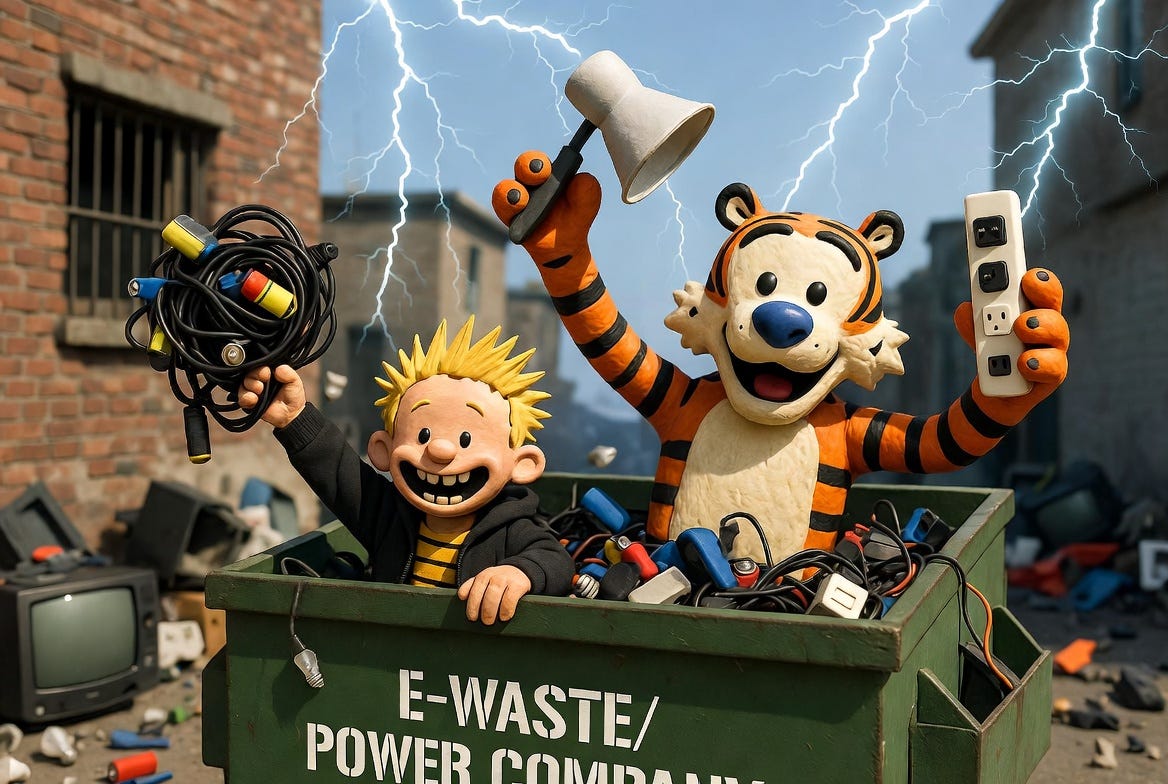
Dumpster Diving for Electricity...
If electricity is the chokepoint... we need to find every available toll booth.

Dear Fellow Traveler,
We interrupt the daily coverage around monetary policy and momentum to tell you…
An insider just bought $100 million of a stock…
Nine figures.
I’m not talking about some marketing officer dipping a toe in $25,000 of their stock.
Or the statistical significance of when a CFO buys their own stock…
I mean $100 million…
And since I’m not one for spoiler alerts… I’ll tell you who it was…
Bill Gates, through his investment company, Cascade Investment.
Let me show you why this is significant…
And why Mr. Gates appears to be “dumpster diving” for the single most important constraint in the economy right now.
Let’s Dive In
Over at Postcards from the Edge of the World, I have beaten the drum that electricity is the constraint of our time. It’s the commodity that replaces human labor, since it is what powers the AI revolution.
Now, let’s see where Money Printer and Postcards (two different publications) merge with our third publication - The Insider Buying Report.
Each morning, I get up and dive into the SEC Form 4 documents that lay out what insiders are buying. I focus on CEOs, CFOs, and 10% owners in the company.
This morning, the filings showed that Gates had a several-day filing that covered purchases in Republic Services (RSG).
Cascade now owns more than 110 million shares, a position worth more than $22 billion.
Now, this doesn’t seem like a huge amount of money for Gates. But when we start to look at what Gates really owns… this is a really compelling purchase.
Republic Services is the second-largest waste and environmental services company in the United States.
It competes against Waste Management, picks up trash, operates landfills, and leads recycling efforts.
About 80% of the business is annuity-like. They generate revenue from long-term contracts that operate under a recession-proof model. Their customer retention rate is well above 90%… And they’ve increased the dividend for 22 years in a row.
This is a boring-ass business in a nation that produces more trash than seems physically possible. The five-year total shareholder return is over 130%… topping the S&P 500.
Adjusted EPS has compounded at roughly 13% annually over the last three years, while free cash flow margins remain strong.
The numbers check out…
Boring is good… boring does what it’s supposed to do…
But I think this is about to get a hell of a lot less boring…
Which brings me back to the constraint…
Actually, three of them…
The Three Chokepoints
This is a world that will run on AI chips… in the cloud… and on the models that ultimately replace human labor markets. And everyone right now seems to be an expert in this in the financial media…
But on the ground of one of my private investments, I get to see what the physical reality is of $700 billion to $800 billion… I see what it really looks like on the ground.
This is construction.
It’s massive, sustained, multi-year construction… I’m talking to concrete operators at my daughter’s lacrosse practice.
I’m seeing steel come in… I’m watching the earth being moved…
It’s an incredible amount of demolition and construction waste, and someone has to haul and process it all…
Someone has to own the landfill where it all ends up…
Republic’s volume framework shows the business is highly tied to housing starts and economic activity, which makes construction and demolition recovery one of the key swing factors to watch.
I’m pretty sure that people aren’t seeing the C&D from the data center build right now.
People aren’t writing blog posts about AI Trash Hauling… but they should.
Republic is vertically integrated in about 90% of its markets.
This is a business that owns the trucks, landfills, and transfer stations. This is a business with a big moat. No one comes in with a pickup truck and a positive attitude and says, “Hey, I just graduated from college, and I’m trying to make a few bucks moving AI data center waste…”
There is no College Hunks Hauling Junk at the scale needed.
Republic Services operates a toll road, and the AI construction boom will create an entirely new lane to plow through…
That’s a major chokepoint.
But wait…
There’s more…
Chokepoint No. 2: There’s Gas in Them Bags
I think that Gates is interested in the next chokepoint.
Republic operates 84 landfill gas-to-energy projects that are currently running. And there are at least another 30 more coming through 2029.
Their latest investor presentation shows a target of $100 million in annual revenue targeting the end of the decade, and $120 million in incremental EBITDA annually from these projects.
Republic partnered with Archaea Energy… a BP subsidiary… on a $1.1 billion buildout of 39 renewable natural gas facilities across 19 states.
They’ve made landfill gas collection a core part of their sustainability strategy, with a 2030 goal of increasing biogas sent for beneficial reuse by 50%.
What are they doing?
They’re capturing methane… which landfills produce naturally from decomposing organic waste…
They’re then converting it into renewable natural gas or electricity.
That energy counts toward corporate clean energy commitments.
And they’re building renewable energy capacity at the same time hyperscalers are desperately searching for power and renewable energy credits.
Now, keep in mind that Gates also owns TerraPower, which is building next-generation nuclear reactors designed to power data centers.
He’s playing both ends of the data center energy problem… nuclear for baseload… waste-to-energy for renewable credits and supplemental power.
Republic’s landfill gas projects sit at the intersection of two things: the AI buildout…
He’s covering the spectrum from energy to environmental compliance.
In other words… the man who helped build Microsoft is buying the garbage company that makes electricity from methane… while also building a nuclear company that makes electricity from uranium.
This is how billionaires think about infrastructure.
Chokepoint No 3:
Remember… data centers don’t just consume power.
They produce an incredible amount of waste.
The cooling systems alone use glycol and other chemicals…
That means the companies need hazardous waste disposal.
Data centers have to decommission server hardware…
They have to get rid of the waste tied to battery backup systems…
Guess what Republic does?
They bought a company called US Ecology that handles PFAS, PCBs, solvents, glycol recycling, and electronic waste… at the industrial scale.
Again, there’s no College Hunks for Chemical Junk…
This is a $37 billion market…
And it’s only about 11% of their revenue.
That will change with time…
This might be one of the biggest runways in American business, but it is sitting as one of the most boring lines I’ve ever read in an investor presentation.
The AI buildout creates waste on the way in (construction), on the way through (hazardous chemicals from operations), and on the way out (decommissioned servers and batteries).
And Republic Services has a toll booth at all three exits.
The Gates Pattern
Gates isn’t making a trade. He owns 35.6% of this company and board seats…
When he adds $100 million in open-market purchases over three days… he’s not guessing. He’s confirming.
And the pattern is pure Gates.
The man is buying chokepoint infrastructure that sits underneath large secular trends.
He’s not buying the flashy thing.
He’s buying the flashy thing that the industry can’t exist without…
Right now, everyone owns NVIDIA…
And every AI data center will need chip input.
But who is paying attention to the outputs… the construction debris, the renewable energy contracts, and the hazmat disposal fees…
Even if AI capex slows at some point, Republic still operates a recession-resistant, infrastructure-grade business sitting in the path of the buildout.
If you’re interested in following insider buying daily, sign up for The Insider Buying Report right here…
And if you want to learn more about Chokepoints… there’s plenty of opportunity over at Postcards from the Edge of the World.
Stay positive,
Garrett Baldwin
You can look the buy up on www.insiderstockbuys.com