
Fwd: Garrett Baldwin - Application to the BIS

Good afternoon…
Several readers have asked what’s next for me professionally…
Yesterday, Japan and South Korea intervened in the currency market while the yen, won (and local stocks), and the Nasdaq 100 were all under pressure. That drove me to start looking at job postings with the Bank for International Settlements (BIS).
I’ve decided to pursue a role that closely aligns with my lifelong interest in financial stability. My cover letter is below.
From: Garrett Baldwin
To: careers@bis.org
Date: July 31, 2026
Subject: Application for Member of the Secretariat
Dear Hiring Committee:
I’m writing to apply for a role with the Financial Stability Board at the Bank for International Settlements in Basel, Switzerland.
The role is Member of the Secretariat, job posting reference JR100438.
Over the last 18 years, I’ve studied and written extensively about financial crises, institutional leverage, collateral chains, central bank facilities and programs, and nonbank institutions like private equity firms and hedge funds.
The longer that I read this job posting, the more deeply concerned I became that I’m very qualified for this role.
As you’ll learn from my resume, I currently engage in all of the responsibilities listed in the job description. I just do them from the outside of a major institution, without a real title, or diplomatic restraint, or anyone authorized in this Hemisphere to stop me.
Just last July Fourth weekend, I read the BIS 2026 Annual Economic Report. I read it cover to cover. I soon published a seven-point dissection with page citations and completed a one-hour presentation on the conclusions to my audience.
Most sane Americans spent that weekend grilling and arguing about politics.
I spent most of it looking at endnote 24.
For that reason, my wife believes she should have veto power over this application.
That said, she has not yet been informed of this job posting or this cover letter.
For years, the Bank for International Settlements (BIS) has transparently told the truth about the structure of the financial system in publicly available studies and PDFs.
I appear to be one of the few people silly and stupid enough to keep finding them and then talking about them as if I’m doing post Super Bowl coverage.
On page 27 of the 2025 report, it notes that hedge funds control over 10% of the U.S. Treasury free float.
On page 63, it explains with a monk’s patience how the yen carry trade directly impacts U.S. financial conditions, as was evident in markets just this week.
And endnote 24 explains that more than 70% of non-centrally cleared bilateral repos have no haircut, something that policymakers aim to shift in 2027 and beyond.
Of course, on the Monday that the Nikkei crashed in August 2024, that man on the television concluded that stocks fell because investors were taking profits.
I admire the BIS because the BIS has never concealed anything. It has published its findings, footnoted them, and sent them to every quarter of the compass. Then the BIS (and people like me) have watched too many people ignore them.
I’ve concluded that financial television networks exist to explain the markets without mentioning the financial system, its plumbing, or how any of these tools work.
The role states that the candidate should be someone who can prepare discussion papers. I have written more than four million words about financial stability, much of it for readers who didn’t ask for those words. There are several who have since blocked me, and Dave from the local pool doesn’t want to hear me talk anymore on Saturdays unless its about the upcoming football season.
My drafts have contained sentences like “the leverage hasn’t disappeared” or “what the **** happens when the funding rolls over in the trillions in Fall 2026?”
I think that I can certainly start a discussion.
Now, I understand why the language in your papers and official statements gets sanded down into very specific vernacular. In most cases, 24 jurisdictions must sign a document, and one careless adjective can move an entire market or start a bank run.
I’d still want to add a translation in the margin for retail investors who are curious about what is actually happening in the financial system as we help shape it.
For example, the BIS might write:
“Intermediation has continued to evolve outside the traditional banking perimeter, warranting continued monitoring.”
I would then translate those beautiful words into:
“The central banks and regulators made banks safer, but the leverage moved somewhere else. Now, we’re in the process of having discussions about who will get the phone call at 2 am and when to break the glass.”
I’m aware enough to know that this first sentence is what would get approved for the final draft.
The second sentence, my sentence, would likely be the reason why Stefon in HR knows me by name and by the sound of my shoes clacking down the hallway.
The job posting also states that a successful candidate would assist the FSB Chair in building consensus “to the extent possible.”
I wish to say that I became briefly confused by the application deadline, which appears first as August 13 and later as Friday, August 14 in the same job posting.
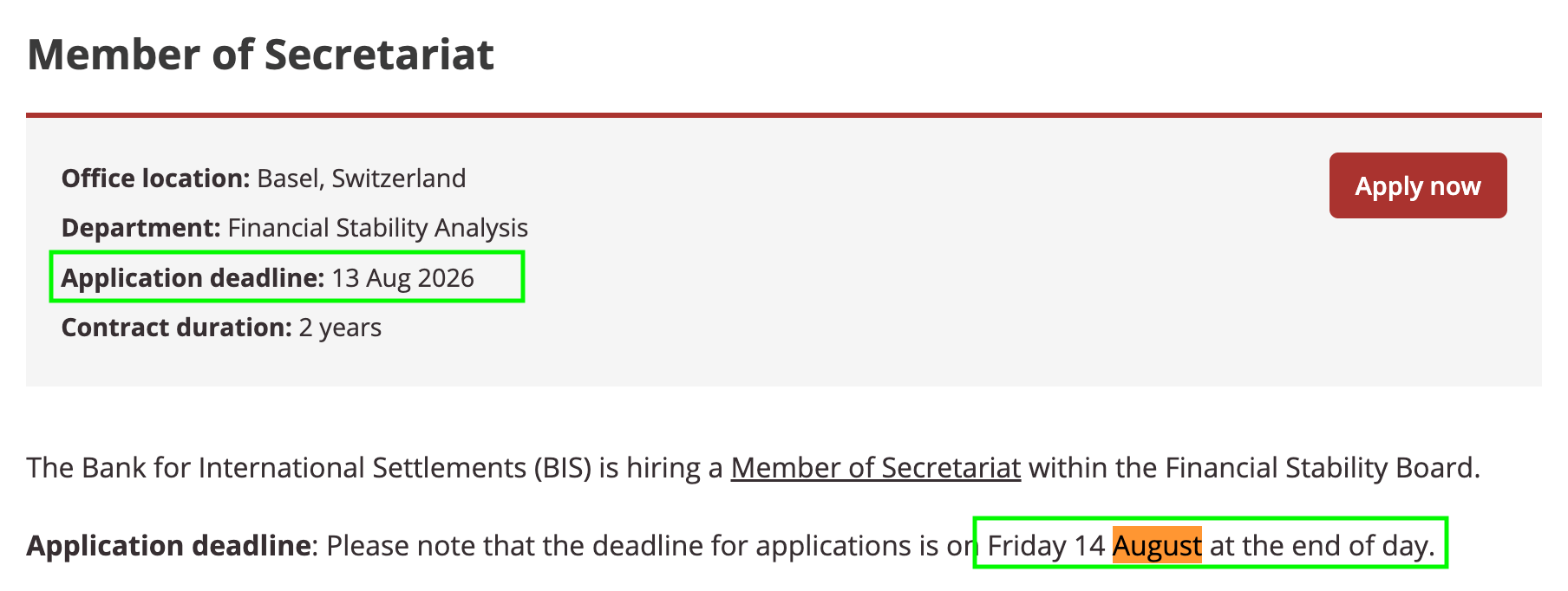
So, I would appreciate the chance to start consensus-building on the proper application date with the job committee before I formally join the organization.
I also need to thank whoever added the four words “to the extent possible.”
This signals that the institution understands the challenges of being an large institution that interacts with other organizations around the globe.
Somewhere inside the BIS, a person understands that 16 regulators can agree that a problem exists, disagree on every noun used to describe it, and then still release a unanimous statement on monetary policy by sunset.
I’d really like to meet that person.
I’d also be expected to “establish and maintain contacts with contact persons,” which is your organization’s coded-way of saying, “Talk to people.” As you can tell, I have read a lot of your work, so I understand the secret language.
Now, I want the secret handshake.
The posting also requires the new employee to prepare meetings, clarify technical issues, and follow up on decisions.
In those follow-up decisions, if 19 institutions agreed one something, I would likely ask which part of the conclusion nobody believed.
“A reform reduces bank balance-sheet risk.”
I agree.
However, I must ask after this… “Where did the risk go?”
Everyone may agree that “central clearing lowers bilateral exposure.”
I agree.
However, please explain why we now suddenly stick everything inside an institution that now becomes Too Big to Fail.
For two decades, I’ve wondered why an institution like the Federal Reserve or the Bank of Japan waits until after the market closes to disclose something that they claim is unimportant. I hope this role will help me satisfy my curiosity on the matter.
This role would allow me to finally be the person receiving that question from people like me to answer those queries via a form letter, “Thank you for your submission. We continue to monitor developments closely.”
Again, I understand why that answer must be careful, as one loose sentence has the ability to create the run or broader market that central banks aim to stop via policy.
I’d still want to add in my form letter that, “We are monitoring it closely because most of the financing has no haircut and everyone owns the same trade.”
Now, I wish to focus on a term in the posting that for the first time in my professional career has made me feel seen. This job posting used the term “nonbank financial intermediation” or NBFI.
I understand why the FSB uses NBFI rather than “shadow banking,” as it is far more technical and accurate. The difficulty in today’s markets is explaining that being a “nonbank” like a hedge fund doesn’t mean “unimportant” in the financial system.
It just means that this institution engages in a lot of “bank-like” activities until that final moment that it needs “bank-like” support from a lender of last resort.
As we know, hedge funds are hedge funds until the Treasury and currency markets stop functioning.
When a hedge fund lead to destabilization, it magically transforms into a “critical intermediation capacity.” It’s then that everyone in Washington, London, and Basel starts calling “contacts” to discuss how insolvent that fund is on paper, and what might affect counterparties and broader bond market function.
I’ve somehow built a career inside and all around that gap in logic.
Every week, I read your reports, find the chart that a lot of people have ignored, and explain why Treasury collateral, repo haircuts, FX funding, basis trades, and private credit liquidity matter to people’s retirement accounts. It is very important to me.
I now might have an untreated health condition linked to studying footnotes.
Now, since you will ask me about my weaknesses in the job interview that I’m definitely penciling into my schedule, I feel the need to disclose them now.
I am always suspicious whenever everyone agrees about anything.
I ask to see the underlying data over someone saying, “Trust me.”
I have an unhealthy interest in collateral and the Secure Overnight Financing Rate.
I tend to ask what happens if everyone tries to leave the same equity or Treasury position at once.
That question usually isn’t on anyone’s agenda, although it definitely ended several conversations well ahead of schedule.
The reason is that I don’t view the idea of “financial stability” as a joke in any way.
That concept, financial stability, really comes down to whether collateral still has a bid in the system, and whether a financial institution is able to even fund this position when everyone else is running to cash.
We’ve learned since 2008 that the system doesn’t break when a TV anchor starts talking about recessions.
It breaks when someone can’t fund the safe-haven asset on a Thursday morning.
My first questions to anyone in a BIS meeting would center on whether the leverage has moved since the last reform or the creation of a new facility.
And, more important, is the backstop still an emergency facility if the whole financial system has organized itself around using it on a permanent basis.
My second question would be where I’m supposed to park.
I acknowledge that after that meeting, someone might tell me that my questions are useful, but might need to be raised through the appropriate bureaucratic channels, and by Friday, some new channel might be created for the sole purpose of making sure that I stay away from the existing ones.
But now you see the problem that I’m facing. It turns out that the BIS may be the only organization left that understands my questions (unless you can help me get direct access or into a war room with Kevin Warsh or Ken Griffin.)
For all of these reasons, I’m available immediately.
Once again, every June, your institution publishes the most alarming document in world finance, the BIS Annual Economic Report. That month, the financial media covers something else.
Every July, I read it alone (sometimes with Mellow Corn), cite the page numbers, explain the leverage, and watch nothing happen until there’s another short-term crisis.
Somewhere during my third year of doing this, I’ve realized that I’m already performing a version of the job described in this posting.
I write documented warnings about collateral, funding, and nonbank leverage for an audience that doesn’t always understand what the hell I am talking about, but is eager to learn.
So, maybe I’m not so much applying for the position as requesting back pay.
Thank you for your time and consideration,
Garrett Baldwin
Well done, sir! Another hilarious spin on the concepts I’m still working to wrap my head around.
Really excellent piece and entertaining, but also tragically true. I have a cold burger somewhere if you are missing one. For now there are just so many places where markets could blow up one option is to sit on a very remote beach, Easter Island comes to mind, and disconnect from the internet; but where to leave the cash and in what currency?