
When a Dollar Learns to Leave the Bank
Washington built a machine that turns digital dollars into Treasury demand. There are consequences to policy... Let's discuss...


Dear Fellow Traveler:
I finished our conversation yesterday with a point that made Gary nervous…
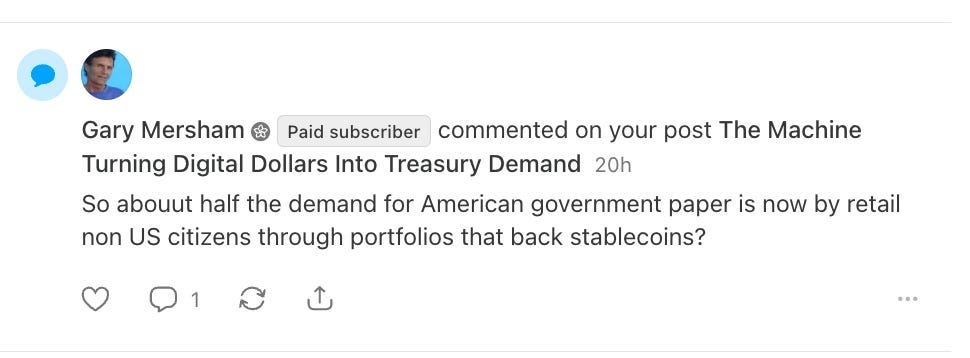
The demand for American debt will come from non citizens through portfolios that are backed by stablecoins… That foreign buyer… the individual… is the marginal buyer…

What could go wrong?
What you think that’s crazy?

As I’ve said, more than 80% of all stablecoin transactions happen outside of the U.S.
I showed you how a dollar has now learned how to leave the entire banking system.
This afternoon, I’ll show you what that term “learned how to leave” really means.
It’s the part of the story that will dominate all of the hallway side conversations in Jackson Hole, Wyoming in three weeks at the Kansas City Fed’s annual symposium.
Everyone About to Be an Expert in Stablecoins
Over the last 100 years, moving dollars across borders required suitcases. There were entire depots down in Buenos Aires, Argentina (there still technically are) dedicated to exchanging U.S. dollars in back rooms at unofficial exchange rates because people were willing to pay more of their struggling currency for the physical greenback.
There were offshore banks handling those funds, and correspondent accounts, and governments like Venezuela that had lost the argument as they fell into hyperinflation.
Now… All you need is a smartphone and an app.
Things get a little weird if you haven’t been keeping up…
The whole debate about stablecoins starts with the Fed’s description of how money moves across borders.
Its March Note (March 30) takes us through that entire process.
Actually processing international payments is a capital-intensive business… but not in the way that we traditionally think of capital intensively linked to factories. It carries very heavy fixed costs.
Smaller banks will route dollars through chains of correspondent banks… basically a middle man who handles domestic banking in foreign currencies.
They do their work without having to open a physical branch abroad. Every single link of the process requires time… adds fees… and requires extensive compliance checks.
Globally, more than half of international payments run on U.S. dollars, and the number of active correspondent banks has now dropped by about 30% in a decade. This means there are fewer tollbooths around the world to handle these pa
The Fed’s note then does something that surprised me… It started to model stablecoins as a workaround to this process. It posited what would happen if smaller banks and individuals started to pay each other across borders directly with tokens.
The Fed isn’t studying if the dollar has the ability to escape the banking system.
It was actually routing the exits for the dollar so it could find itself in the hands of people outside of the United States.
The Bank of International Settlements Sounds a Bull Horn
When the central bankers arrive in Wyoming, the advocacy for stablecoins will be strong among the Western contingent.
But other central banks are a bit worried. The Bank for International Settlements (BIS), whom I want to join in the future and be a part of the fun, published a very important paper in July.
The paper compared stablecoin flows and functions to old-fashioned dollarization across more than 130 economies.
It reads like a storm warning for anyone who runs a central bank that is not operating around the U.S. dollar. Stablecoin dollarization (largely the adoption of them as a preferred payment form over the local currency) is the same process that would drive people in another nation from using their own money.
There are concerns about inflation passing through the exchange rate, banking crises, and governments facing future fiscal troubles. Dollarization is persistent and very difficult to reverse once it gets started, as it happens at the individual level… and it has network effects.
This finding will keep the central bank leaders of emerging-market economies on guard. Nothing is more damning than this conclusion… It’s that capital flow restrictions - which aim to reduce the amount of traditional dollar deposits and demand for the dollar - have no significant impact on stablecoin flows.
This is because these stablecoins would operate outside of the traditional regulatory framework… and make it harder for anyone to stop.
How It All Works
Capital controls are supposed to be a wall around the banking system…
But stablecoins don’t need to climb a wall, since they snuck into the neighborhood on a smart phone.
And what’s fascinating about this story is that there is a bit of a zero-sum game to the currency system. The very thing that might terrify a central banker in Uruguay or Algeria will look like a growth chart down in Washington D.C.
A person who is fleeing the peso for the U.S. dollar… They represent two things.
On one side, they’re part of a continued erosion of monetary sovereignty, a falling depositor base at home, and an interest policy rate that will lose its grip on the local system.
On the other side, that same person holding stablecoins is a person creating new demand for U.S. dollars, and through the rules we explained yesterday, a new marginal buyer of U.S. Treasury bills.
One nation’s capital flight turns into America’s customer acquisition.
And while they all gather in a few weeks, no one actually knows how big this could get… The Fed’s cross-border example intentionally sets aside the “store of value” use case… they’re making a very polite assumption that foreign stablecoin holders would hold as few dollars as possible. We know that’s probably not true…
The BIS measured what people really do with their money. What their evidence shows is a historical record of moderate dollarization that produces some higher inflation risks, but not an implosion of local monetary policy.
Money that can arrive at the speed of light can now leave anywhere at the speed of light… The old bank runs started on sidewalks in one nation… during set hours at the location.
But now the next run can start on millions of phones, across time zones, over a weekend… while half of the world is asleep.
And it would run through the same dollar system that the rescue teams are supposed to protect with countless “break-the-glass” policy decisions.
The people who publish these papers know this…. which is why, they’ve already started to build a new rescue system… before that system exists.
Tomorrow, in Part V, I’ll explain the system that they’re building and what you need to do moving forward.
Then, on Saturday, Money Printer Pro readers get access to a full report on a recommendation from this week.
We’re tapping into one name that has a consensus 56% upside from today’s current price. Get access to the report for Jackson Hole and the stock pick…
A special bonus from Me and the Money Printer…
And be prepared for what comes in September as we add new tools to our existing platform of momentum stocks, momentum readings, and options calculators… a total platform that can save you hundreds of dollars in stock platforms every single year.
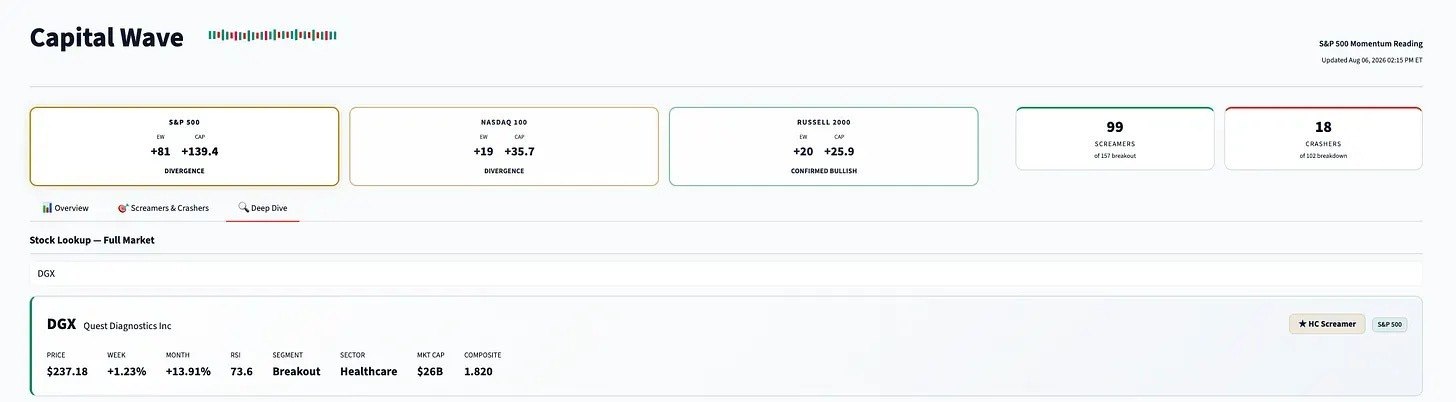
Then, get your password to Money Printer Pro so you can see our signals, and where all your stocks are in the seven cycles of momentum. DGX is currently in Breakout.
Stay positive,
Garrett Baldwin
Sources
Washington also built a machine that will now launder b-b-billions of dollars of drug money by allowing it back into the banking system at full value + interest, instead of 50 cents on-the-dollar.
"And you can take that to the bank." Risky Business, 1983